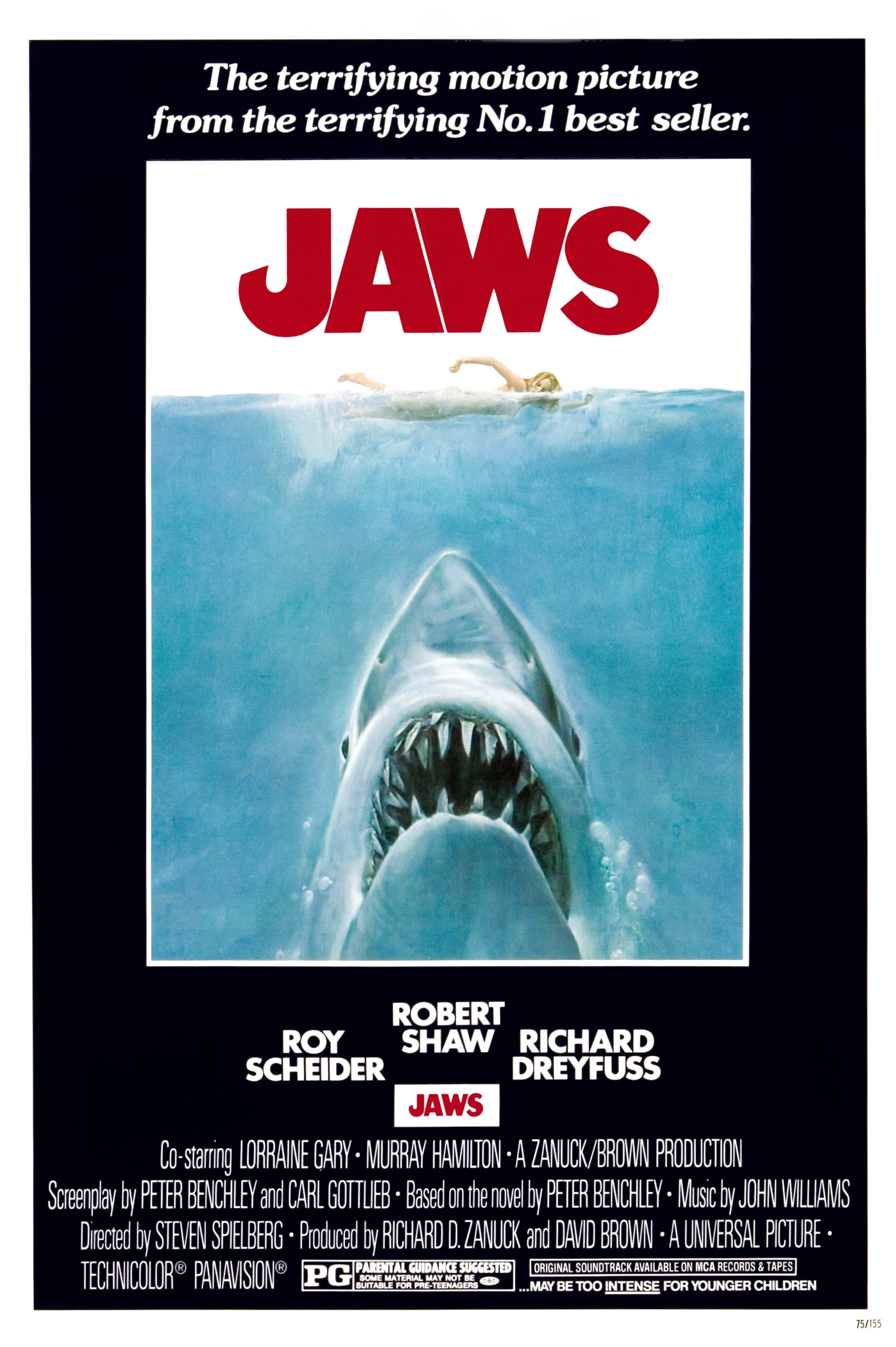
The great fish moved silently through the night water, propelled by short sweeps of its crescent tail.
What a way to begin a book! It’s calm, careful, and even sensual. That’s from Peter Benchley’s novel Jaws. The movie starts differently. It opens underwater, on the fish’s own point of view, with two notes doing the work the camera refuses to do. Then it cuts to a bonfire on the shore. Chrissie, a young woman, smiles at a young man named Tom, and he follows her down to the water. She quickly decides that a midnight swim is required and proceeds to disrobe and run into the water. Tom is eager to follow, and tries, but he’s too inebriated. A minute later, she’s fish food.
Fifty years on, most people going into either the book or the movie know more or less what’s going to happen, and the tension increases. You know she’s going to get it, but you can’t help being nervous for her.
That’s how the story begins. As with any story, outside of those wibbly-wobbly avant-garde ones, it also has a middle and an end.
The shark gets the girl, and then a few more people. The town argues about what an appropriate response looks like. A decision finally gets made, and a small team goes out to take down the shark.
Your story has all of that, doesn’t it? So why does the middle of your draft feel swampy?
You’ve got a three-act structure, but your second act just isn’t working. It slogs through what could be an exciting, intriguing section.
Why?
The three-act structure is a proportional system — roughly a quarter, a half, a quarter — with two hinges. There’s a fair chance that your draft doesn’t have either hinge.
As we examine this, we’re going to look through the lens of the movie Jaws. From here on I am working from the film, not the novel. The two diverge, and they diverge hardest at the end. If you haven’t seen the movie, go to your favorite streamer and see if you can find it. I saw it in the theater as a kid, and I became convinced that Mrs. Kirk’s pool next door had sharks. It’s that good (or Mrs. Kirk wasn’t the nice lady I thought she was).
We’ll do it act by act. Keep reading.