


It’s a reasonable question. What's a story? Sure, we know one when we hear (read) one, but as writers, we can approach it from a creator’s perspective. So, what, then?
Something happens. That’s a story. Let’s not make this too complicated.
For something to happen, something must be doing the happening. That’s the subject of the story. What is happening is where we find conflict and resolution.
That’s most of the story right there.
Then we’ve got to consider characters, setting, and all those other things you learned in eighth grade.
Without something happening, nothing, um, happens. You might have created an atmosphere, tension, or a vibe. But not a story.
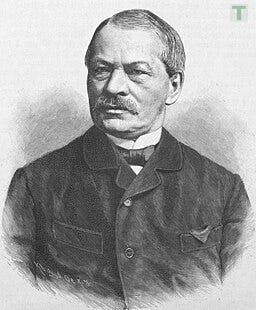
I generally follow what’s called Freytag’s Pyramid. No, I don’t know who Freytag was. You can read about him on Wikipedia. This guy. You can see in the photo that he looks so smart and stately that we’ve got to believe him.
We’ve got a couple of other structures you can think through and I’ll address them in subsequent articles: Three-Act Structure, The Hero’s Journey, Fichtean Curve. It’s not a right or wrong scenario. Once you know them, you’ll choose the one that makes sense both intuitively and on a craft level.
Back to Gustav Freytag, or, more importantly, his famous pyramid. It’s excellent for classical tragedies, linear moral fables, and traditional short stories.
Exposition
Rising Action
Climax
Falling Action
Resolution (also known as the Dénouement)
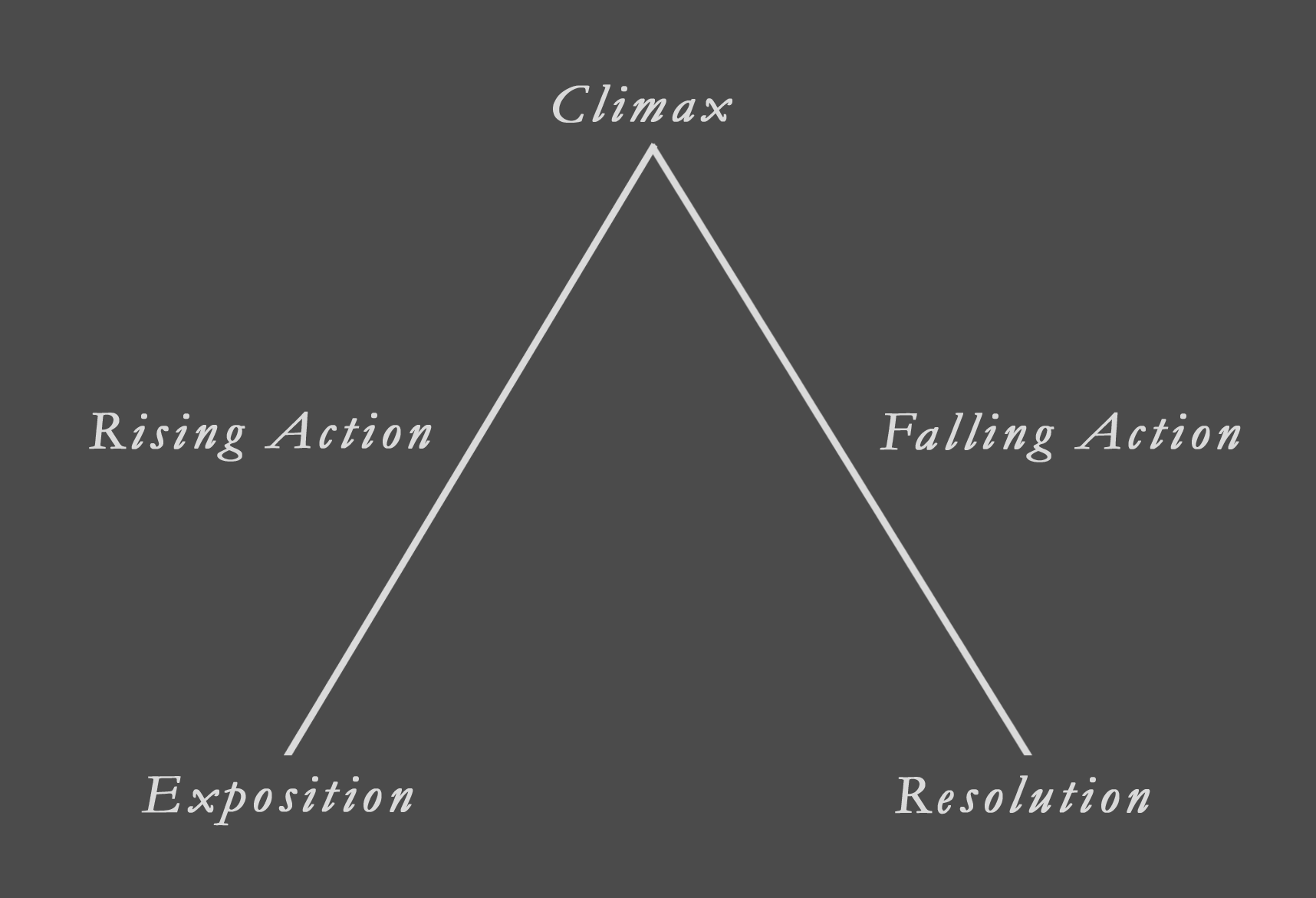
I know, I know, it’s not really a pyramid. I think it should be presented more like a bell curve, but in textbooks it is drawn like a teepee. We didn’t call that when I was in grade school. We just called it the structure of a story.
Let me dig a little bit into what each category does.
Exposition
This is where you set things up. Where is the story happening? That’s both a general question and a specific question.
Think about the Andy Griffith Show (TAGS to hardcore fans). Is the story happening in Mayberry? Is it happening in the building where Andy works with Barney? Is it very specifically happening around Andy’s desk?
As you tell more of the story, the reader will learn that it’s in the American Southeast in a small town. The reader won’t know much about Mayberry, but he will know that, and that’s the only important thing. Whether Mayberry is in Georgia, South Carolina, or elsewhere doesn’t matter.
That context should include some sensory descriptions. Is it dusty? Can I hear the clanking of Otis locking himself in the jail cell? Is there a quiet echo to the otherwise empty room? Imagine this is in your book and not on television. You would need to describe the simplicity of the jail cells, the color of Andy’s desk, and the way the light shines on the floor. This helps readers be in the room themselves.
You bring out a couple of characters and help us understand how they’re different and why they initially matter.
And this story, maybe you’ve got Andy, Barney, Otis (the town drunk), and then Opie walks in for a quick exchange before leaving.
We already caught a little bit about Otis as he locked himself into the cell. He’s a disheveled man in need of a shave and a toothbrush, and probably a cure for a forthcoming hangover.
You need some clues so the reader can learn about Barney. Part of his success as a character was how he fumbled through his job full of earnest and thorough incompleteness. He wanted to do his job well, but he wasn’t very good at it at all. His character would need descriptions because physical comedy was part of his thing. His clothes didn’t quite fit, as he was gangly. You would need to show me how awkward and overbearing he was. There’s a lot to describe about Barney, and there’s a lot to describe about every other character in Mayberry. Mayberry is character-driven, and if you were writing the story as a book, you could have a field day.
Rising Action
We’re getting some cues to what might be happening. Foreshadowing is worked in here as it would be also in the initial section. Some little stuff might be happening.
Maybe Barney is telling Andy about an Inspector who is coming soon. He’s panicking as he knows the sheriff takes things casually. After all, it’s in Mayberry and Otis and Ernest T. Bass are the hardest criminals they’ve got.
With the rising action, the author moves things around to create a problem for the protagonists. To clear the way, something needs to change. Is a mobster coming into town? Is Aunt Bee going away for the weekend? Whatever is going to happen hasn’t happened yet, but the pieces are in place.
For example, in the story about inspection, we find out that Andy’s friend, the inspector, isn’t coming at all. Another inspector is coming who might not be quite as friendly. Andy, who previously considered the situation nonchalantly, is now understandably concerned.
The inspector finds out that the filing system is a mess. The jail cells are unlocked. Andy lacks modern equipment. Barney tries to impress the inspector. He overdoes it, as he always does. It goes on and on.
Climax
There’s lots of action in a climax, whenever what is happening is happening.
What is happening is that a man who Andy once sent to prison comes back to Mayberry. The inspector is expecting a violent confrontation. Andy’s folksy approach is facing a big test against the inspector’s “by-the-book” fear of criminals.
Falling Action
Things are still going on after the big test. The climax is no longer a threat but its effects remain. You can see the consequences of the big event even though everything is not yet tied into a tidy bow. This is where the inspector finds out Andy is the best sheriff for Mayberry. Andy confronts a crisis situation effectively but never strays from his easy-going persona.
He greets the man with respect and in return, the ex-offender likewise offers respect. There’s no shootout. No big arrest. The man just came to thank Andy for the fair treatment he received during his previous arrest. He also wants to tell Andy that he’s turned his life around.
Resolution (Dénouement)
A dénouement is the fancy French loanword term English majors learn for what is simply the resolution. When writers get together, we break out our Scrabble-champ vocabularies, even if we probably pronounce the French word incorrectly.
This can be a brief scene that involves a cowboy kissing his girl before riding off into the sunset. It could be a big dance scene. It could be where characters give their final goodbye to a hero who might have died to save the world, like what we saw in Avengers: Endgame.
In the case of this Andy Griffith episode, the inspector recognizes Andy might not follow any manual, but he is extraordinarily effective. He realizes Mayberry’s sheriff has the respect of the town, which is maintained through relationships and his good character.
He decides not to file a harsh report, and Andy and Barney go back to their usual routine.
Nip It in the Bud!
It’s good to know this basic structure. It’ll cover a lot of shorter pieces of writing and is worth keeping in your intellectual back pocket.
As you plan your story (more on this in a later article), you can see any likely plot problems before you write one word. Your story will have a better structure as a result while minimizing problems.
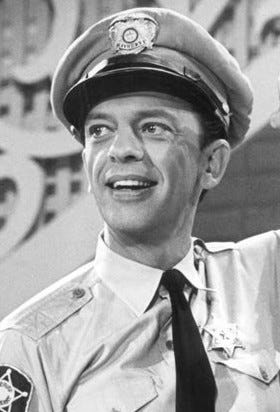
You can, as Barney Fife was apt to say, “Nip it in the bud!”
Two Sentence Story Prompt
Here’s a quick prompt to push you forward.
The local sheriff finds a rusted 1950s sedan unearthed by a flash flood, its engine still warm despite the vehicle being reported missing since 1964. Inside the glovebox, a handwritten note dated tomorrow warns the town to evacuate before the sun sets.
A Not-Funny Joke
Ellipsis... “I have run out of ideas and hope you'll finish the sentence for me.”